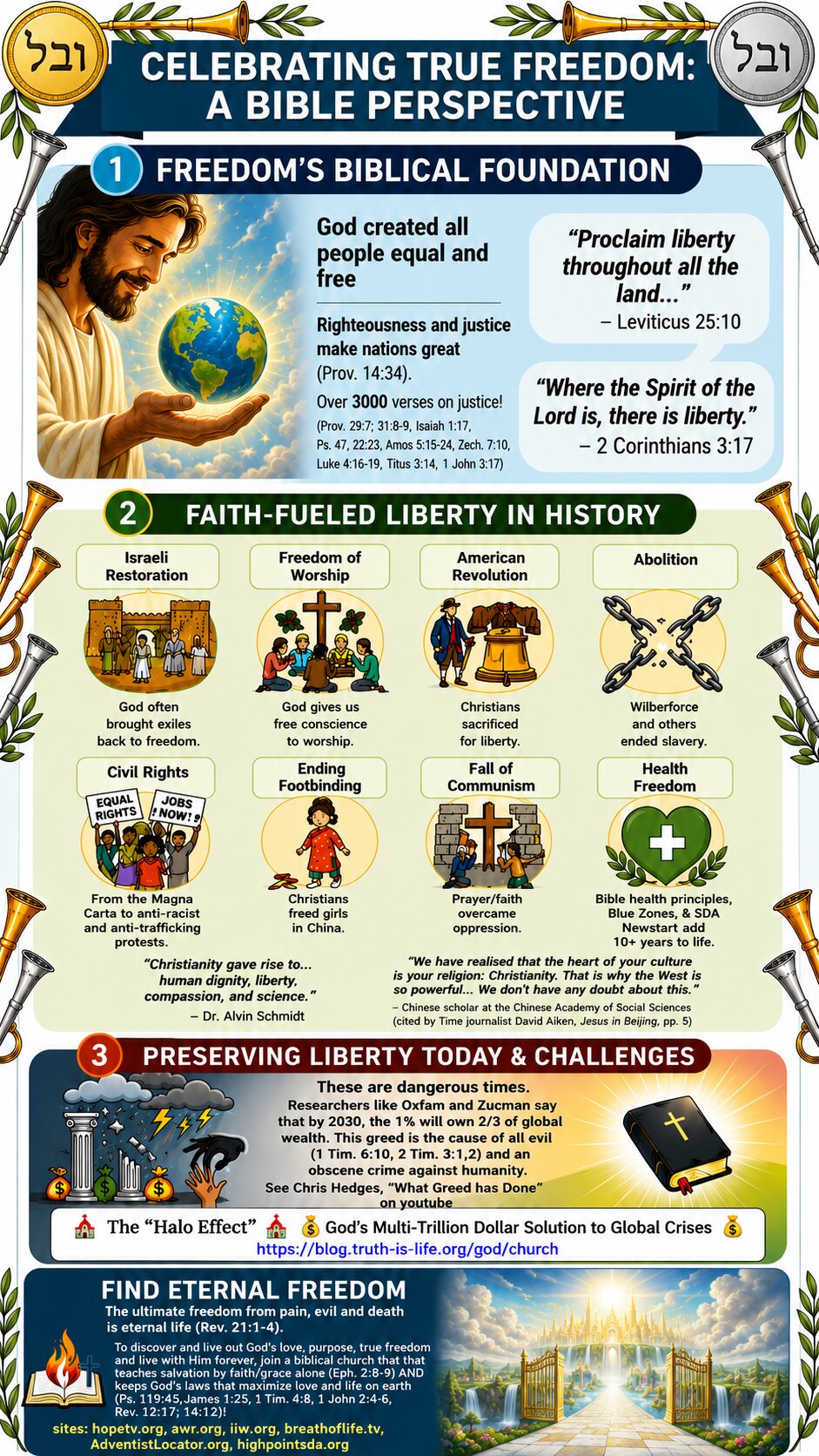
The Enduring Flame: Faith as the Architect of Liberty
As we celebrate Juneteenth, Independence Day, and other celebrations of freedom in various countries, we reflect on how nations were founded on principles of liberty and self-governance. This is an important moment to recognize the profound role that faith has played in inspiring movements for freedom across the globe. From the restoration of ancient cities to the fall of the Iron Curtain, the unwavering conviction of people of faith has been a driving force in the pursuit of justice, equality, and the unalienable rights bestowed upon humanity by a Creator.
A) Bible Verses That Ignited the Spark of Liberty
Throughout history, movements striving for independence and justice have drawn strength from the enduring truths of the Bible. These verses served as moral compasses for those who dared to dream of a freer, more just world:
- Proverbs 29:7 (NLT): “The godly care about the rights of the poor; the wicked don’t care at all.”
- Proverbs 31:8-9 (NLT): “Speak up for those who cannot speak for themselves; ensure justice for those being crushed. Yes, speak up for the poor and helpless, and see that they get justice.”
- Leviticus 25:10 (NLT): “You will set this fiftieth year apart as a holy year and proclaim liberty throughout the land to all who live there. It will be a jubilee year for you…”
- Isaiah 1:17 (NLT): “Learn to do good. Seek justice. Help the oppressed. Defend the cause of orphans. Fight for the rights of widows.”
- Amos 5:21, 24 (NLT): “I hate all your show and pretense—the hypocrisy of your religious festivals and solemn assemblies… Instead, I want to see a mighty flood of justice, an endless river of righteous living.”
- Luke 4:18-19 (NLT): “The Spirit of the Lord is upon me, for he has anointed me to bring Good News to the poor. He has sent me to proclaim that captives will be released, that the blind will see, that the oppressed will be set free, and that the time of the Lord’s favor has come.”
- James 1:27 (NLT): “Pure and genuine religion in the sight of God the Father means caring for orphans and widows in their distress and refusing to let the world corrupt you.”
- 1 John 3:17 (NLT): “If someone has enough money to live well and sees a brother or sister in need but shows no compassion—how can God’s love be in that person?”
B) Christianity: A Catalyst for Progress and Pluralism
The Christian worldview, emphasizing the inherent dignity of the individual, has empowered movements that champion human flourishing. Here are ten examples where biblical conviction sparked transformative freedoms:
- Israeli Restoration: Motivated by the biblical promise of return (Nehemiah 2:17-18), leaders like David Ben-Gurion (Israel) integrated biblical Zionism with modern governance to re-establish a sovereign Jewish state after centuries of exile.
- Universal Human Rights: Believing in the Imago Dei (Genesis 1:27), Dr. Charles Malik (Lebanon), an Arabic Christian philosopher, served as a principal author of the United Nations’ Universal Declaration of Human Rights, ensuring that rights were grounded in the inherent dignity of the human person.
- Labor & Cooperative Rights: Driven by the early church’s example of sharing resources (Acts 2:44-45), Kagawa Toyohiko (Japan), a noted Japanese Christian, pioneered the cooperative movement and fought for the rights of laborers to organize, striving to eliminate systemic poverty.
- Indigenous Dignity: Championing the equality of all nations (Galatians 3:28), Bartolomé de las Casas (Spain/Americas), a Dominican friar and Christian, spent his life advocating against the enslavement of indigenous peoples in the Americas, successfully lobbying for early human rights protections.
- Labor & Civil Rights: Inspired by the cries of the oppressed (James 5:4), Cesar Chavez (USA/Hispanic), a devout follower of Jesus, utilized non-violent protest and prayer to secure labor rights for thousands of field workers, modeling his work on the teachings of Christian social justice.
- Women’s Rights & Education: Guided by the mandate to speak up for those who cannot speak for themselves (Proverbs 31:8-9), Pandita Ramabai (India) and Alicia Little (missionary in China) defied cultural norms to establish schools and homes for widows, providing education and freedom from oppressive caste and gender systems.
- Health Freedom: Motivated by the belief that the body is a temple (1 Corinthians 6:19-20), pioneers like Ellen G. White (USA) promoted holistic health principles, which modern research—such as “Blue Zones” studies—confirms leads to significant increases in longevity and quality of life.
- Fall of Communism: Relying on the promise that “where the Spirit of the Lord is, there is freedom” (2 Corinthians 3:17), figures like Pastor Christian Führer, who led the prayer services at St. Nicholas Church that ignited the Peaceful Revolution, and the Solidarity movement led by Lech Wałęsa, utilized peaceful prayer and moral courage to crumble oppressive regimes in Eastern Europe.
- Republicanism & Modern Democracy: Inspired by the belief in equality before God (Genesis 1:27), Sun Yat-sen (China), known as the “Father of Modern China,” drew upon his Christian faith to champion democratic governance and republicanism, aiming to replace dynastic tyranny with a government of the people.
- Nonviolent Independence & Conscience: Rooted in the commitment to truth and nonviolence (Proverbs 31:8-9), Cho Man-sik (Korea), a devoted Presbyterian leader often called the “Korean Gandhi,” led nonviolent resistance against Japanese occupation and later stood against communist tyranny, prioritizing the freedom of the Korean conscience.
C) Preserving Freedom in Perilous Times: The Indispensable Role of Healthy Biblical Churches
We live in a time of precarious stability. Recent reports highlight a startling trajectory of wealth concentration; Oxfam International warns that the top 1% of the global population is on track to control two-thirds of all global wealth by 2030 (Oxfam International). Concurrently, the moral and intellectual health of the church is under pressure; research from the Barna Group indicates that only 4-17% of American Christians—and even among pastors, only about 50%—hold a comprehensive, functional biblical worldview (Barna Group).
This decline in biblical literacy is inextricably linked to the rise of systemic greed. Without a transcendent standard, society defaults to materialism and the consolidation of power. In such a climate, healthy biblical churches emerge not just as places of worship, but as critical bulwarks against tyranny. From a scientific and sociological perspective, here is why they are indispensable for preserving freedom:
- Cultivation of Moral Capital and Ethical Frameworks: Churches provide a consistent moral framework rooted in timeless biblical principles. This fosters virtues such as honesty, integrity, compassion, and self-control—essential ingredients for a thriving, free society. When these moral foundations erode, societies become susceptible to corruption and authoritarianism. Studies in social capital consistently show that religious communities are incubators of trust, reciprocity, and civic engagement.
- Promotion of Voluntary Association and Civic Engagement: Healthy churches are vibrant examples of voluntary association, fostering strong community bonds and networks of mutual support. This participation strengthens civil society, creating a counterbalance to state power and encouraging citizens to engage in the democratic process. Research in political science highlights the critical role of robust civil society organizations in democratic stability.
- Development of Critical Thinking and Conscientious Objectors: While often perceived as promoting conformity, healthy biblical churches that emphasize theological depth and personal study of scripture encourage critical thinking. This empowers individuals to question unjust authority and act as conscientious objectors against policies that violate moral principles, serving as a check on tyrannical impulses.
- Providing a Transcendent Authority: A belief in a transcendent God provides a standard of truth and morality higher than any human government or ideology. This prevents the state from becoming the ultimate authority and protects individual liberties. When there is no higher authority, the state can demand absolute allegiance, paving the way for tyranny. Crucially, the Bible teaches that all wealth is a trust from God, not a product of ultimate individual ownership (Psalm 24:1). A healthy church instills this stewardship mindset, directly challenging the “winner-take-all” mentality that leads to extreme inequality and corruption.
- Fostering Resilience and Hope: In times of crisis and oppression, faith communities serve as vital sources of resilience and emotional support. This spiritual fortitude enables individuals to persevere in the face of adversity and continue striving for freedom even when circumstances are dire. This psychological strength is a powerful antidote to the despair and apathy that allow tyranny to flourish.
As we celebrate our hard-won freedoms this year, let us recognize the profound contribution of faith to the preservation of liberty. A vibrant, morally grounded citizenry, nurtured within healthy faith communities, remains our strongest defense against the forces that would diminish our freedoms.
References
- Barna Group. “The State of the Church in America.” Barna.com, 2024. www.barna.com. This research tracks the alarming decline in biblical literacy and worldview among both clergy and laity, highlighting the need for theological renewal to maintain a free society.
- Oxfam International. “Survival of the Richest: How we must tax the super-rich now to fight inequality.” Oxfam.org, 2023. www.oxfam.org. This report provides data on extreme wealth concentration, illustrating the economic instability and risks to democracy that arise when unchecked corporate and individual greed dominate.
- Holy Bible, New Living Translation. Tyndale House Publishers, 2015. www.tyndale.com. All scripture references utilize the NLT for its emphasis on clarity and modern readability, often used by modern movements to connect biblical principles to contemporary justice.
- Woodberry, Robert D. “The Missionary Roots of Liberal Democracy.” American Political Science Review, 2012. www.cambridge.org. This seminal academic study validates the historical role of Protestant missions and Christian activism in fostering education, civil society, and the democratic freedoms enjoyed in many nations today.